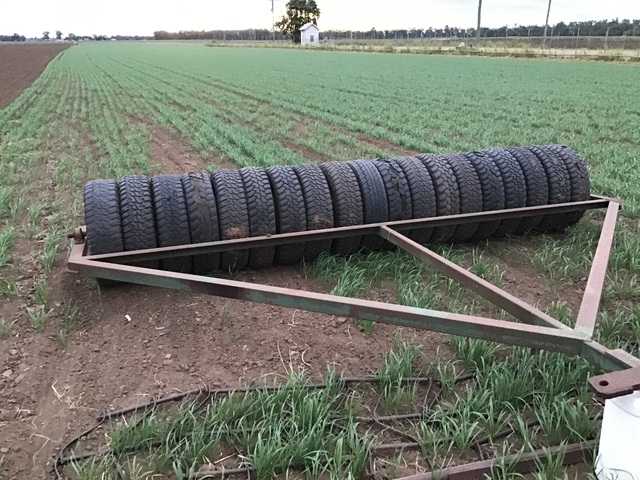
The photo attached is of an age-old piece of machinery—a rubber-tyred roller—that is still very important for various cropping options.
Farm machinery has certainly changed a lot compared to our 1950s and ’60s Sunshine planter combines. They tilled the soil, planted the seed and covered it over, and were a huge plus in the agricultural scene of the time.
Today, planters are predominantly just seed placement machines with a press wheel of some type behind the planter tine, to compress the soil onto the seed in the seed trench.
However, many of these new planters, whilst being super accurate in planting rates or seeds per hectare placed, usually don’t till the soil or leave a flat surface post-plant.
So what is wrong with that, you say?
Some crops, like our favourite winter pulse crop of chickpeas, can be planted relatively deep in the soil. However, what happens around the soil surface zone at that critical planting date is important in regard to our harvest time.
The first consideration is the height to the lowest pod on our chickpea bush. This is the distance between the lowest pod and the soil surface at the base of the plant. So, if the planter leaves a trench above the seed placement zone, that reduces the overall height to the pods on the chickpea bush. Therefore, the header comb has to go lower to pick up those valuable pods with seed in them. However, picking up dirt with the harvester comb because of low pod height is not good for quality or yields. Many low-hanging pods can be left behind, as they may even be below the top of the seeding trench.
Therefore, leaving a flat surface above the planting row makes for an even and more advantageous harvest operation—this is the first positive point.
Our breeding organisations were, in the past, conscious of this varietal trait of maximising the height to the lowest pod.
The second major advantage of leaving a flat surface in the newly planted chickpea paddock is the positional safety for any post-plant, pre-emergent herbicide applications.
Most of our herbicide options for chickpeas are applied straight after planting and before emergence. The crop safety levels can be lowered by leaving a deep V above the seeding line—in other words, there is not much soil above where the seed has been placed by the planter.
Apply the herbicide, then some steady rain may occur and—hey presto—the rainfall solubilises the herbicide and moves it into the shallow root zone of the chickpea plant.
This can damage or even kill these small seedling chickpea plants.
So, leaving a flat surface post-planting for many newly planted crops like chickpeas can really enhance the crop safety angle.
Hence my photo of the rubber-tyred roller—as this simple piece of machinery can prevent a lot of issues like low pod height and reduced crop safety, simply by rolling the paddock after planting and before crop emergence.