
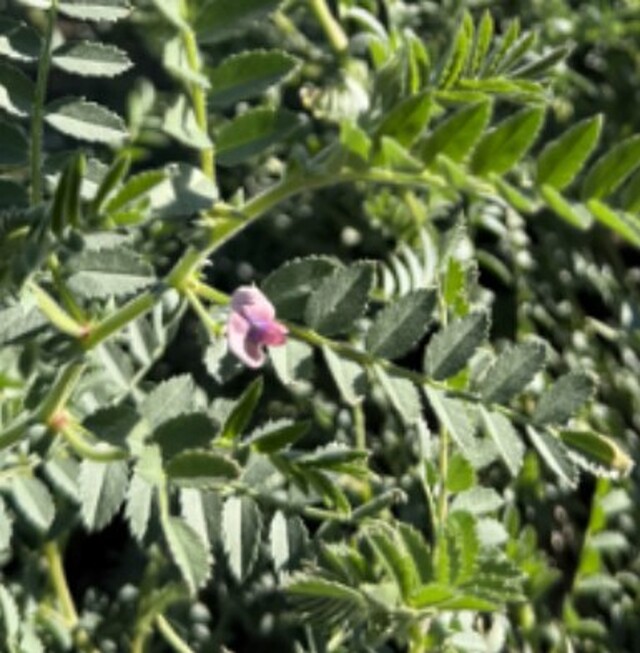
It’s mid-June, and in a well-grown Central Queensland chickpea crop, flowers are starting to appear.
Thanks to Alex Doyle, a great young agronomist in Central Queensland, we have a photo of one of these early blooms.
Is it unusual for chickpea flowers to appear at this time?
Probably not.
When we consider the accumulated degree days or heat units in this region, crops planted on similar dates have now reached around 1000 cumulative degree days (Cd).
That explains why we’re seeing flowering.
When we talk about degree days or heat units in plant development, we’re simply referring to the thermal time needed for a crop to reach specific growth stages – such as flowering.
Many industries use this measurement, including the cotton industry, and I use it myself for mung beans and chickpeas.
It helps estimate likely flowering dates and, in the case of pulses, it’s especially useful for calculating physiological maturity.
This is particularly important for mung beans, where late planting carries significant risk.
So, how can you make a rough calculation of degree days for your chickpea crop?
And is there anything you can do in-crop to manage potential issues related to thermal time?
The short answer is: no, there’s no in-crop management that can change how thermal time affects a crop’s growth.
The only real control is the time of sowing.
Everything starts with understanding the base temperature for your crop.
This is the lowest temperature at which development continues.
Below this threshold, the plant essentially stops progressing – whether at germination or later stages.
For chickpeas, the base temperature is 0°C.
Some of my farming friends on the cooler eastern Darling Downs, for example, prefer not to plant chickpeas until July or even August.
By contrast, mung beans and other summer crops have a base temperature of 10°C.
Planting chickpeas much earlier can lead to very slow germination and emergence, with almost no above-ground growth for several weeks.
Even the orientation of your paddock – north- or south-facing slopes – can affect the heat accumulation.
Later planting might not give them the big four to five tonne per hectare yields, but it can still work well within their overall farming system.
To calculate degree days for chickpeas using a rough method:
1. Add the daily maximum and minimum temperatures.
2. Divide the total by two to get the average temperature.
3. Subtract the base temperature (0°C for chickpeas).
For example, if the day’s maximum is 35°C and the minimum is 10°C:
* (35 + 10) / 2 = 22.5
* 22.5 – 0 = 22.5°C of degree days accumulated for that day.
If you assume a crop needs 1000 Cd to reach flowering, divide 1000 by 25 (an example average daily accumulation), and you get 40 days.
So, this crop may have been in the ground for about 40 days.
Now, what happens next in this chickpea crop as we see its first flower?
Like many crops, chickpeas are sensitive to weather extremes.
Flowering and pod set can fail if average daily temperatures fall below 15°C.
You might see plenty of flowers, or even some early seed pods, only for them to abort after a cold snap due to sterile pollen.
The crop then needs warmer conditions – again, average daily temperatures above 15°C – for successful re-flowering and pod formation.
Of course, this also depends on having adequate soil moisture, which isn’t always guaranteed – especially in drier years or on double-cropped land.
As with many crops, the best sowing decisions still depend heavily on weather conditions.
All we can really rely on is our farming experience and our best guesses at what the next few months might bring.
More on how frost events impact our pulse crops – coming next week, folks.