
No doubt about it, you just have to remain in our agricultural industry long enough, promoting best management and cutting-edge extension practices, and hey presto, you may end up with answers to a range of questions you had not even thought of.
What am I on about today? In a word: Hormesis.
What is Hormesis, you ask?
Here is some background on what the term Hormesis refers to.
Many decades ago, we started this zero or minimum tillage farming system.
Plenty of positive points arose from this revolutionary farming system, and it is a very accepted agronomy fact of Aussie dryland or rainfed farming systems these days, where weed control is mostly done by various herbicide applications like Glyphosate.
Certainly, young agronomists like myself in those 1980s developed our own skills in this conservation farming process, and controlling weeds in fallow situations with herbicide involved a fair bit of trial, and unfortunately, errors.
One of the errors was not achieving a complete kill.
In other words, if the spray job gave us 95 per cent control of the weed population, we believed that was a satisfactory result.
Roll on to the current years, with observations and research done in fallow paddocks, and we now know that having any survivors is not good practice, due to the increase in herbicide resistance in various populations of weeds like Sowthistle and Barnyard Grass, to name a couple.
What has been recently discovered by a friend of mine, Eric Koetz of NSW DPI, in conjunction with Dr Azad, is that these survivors of some species of weed have really thrived on these non-lethal rates of herbicide.
What also can occur in these weeds is that they show a fitness advantage in response to these lower doses of herbicides like Glyphosate.
By that, I mean they can grow more biomass and, more importantly, many extra seeds than the same cohort of weeds that were unsprayed.
That is called a hormetic response, and plants stimulated like this can produce a large quantity of seed.
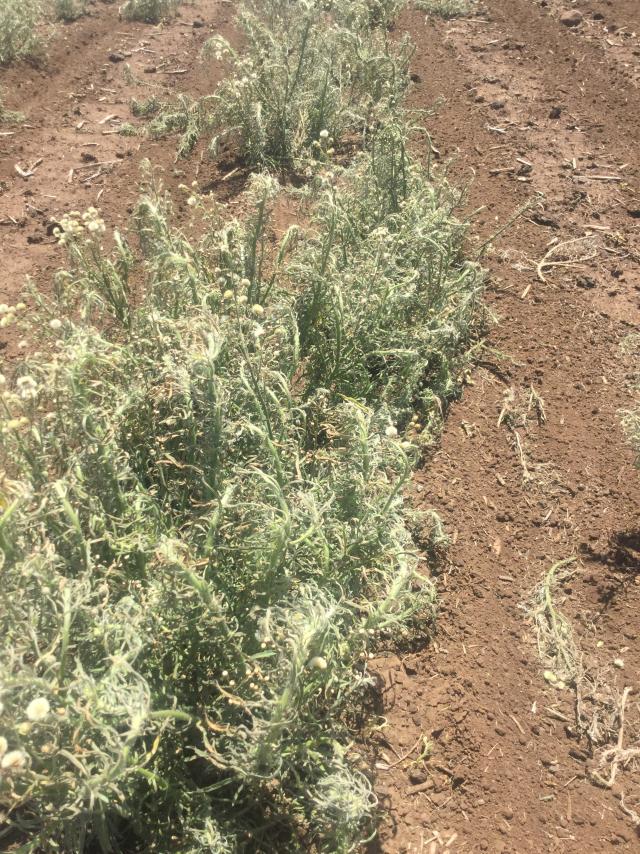
I do recall seeing this phenomenon on the Darling Downs many decades ago in survivor Fleabane plants, after a farmer client had applied three litres per hectare of a Glyphosate 540.
There was a huge proliferation of seed produced on these scattered Fleabane plants, and of course, they were not going to die from this previous herbicide application.
So, I advised the farmer to spray these highly active seeding broadleaf weeds with another robust glyphosate rate again, using an early version of an optical sensor sprayer.
The reason for this not exactly effective second recommendation was that any spray drift from other effective herbicide options could have been a major issue with sensitive crops very close by.
The end result from my decades-ago observations was some shorter Fleabane plants with a massively large seed count on them, now called Hormesis.
My rough calculations after they matured also suggested some lower germination rates from these masses of Fleabane seeds.
The overall end result still comes down to having no weed survivors, and preferably no weed seed set either, post any herbicide applications.
Exactly like two of our WeedSmart Big 6 tactics for practical solutions to reducing and stopping herbicide resistance.